How to Break 85 in Golf Consistently – A Practical Guide & 7 Proven Tips for Better Scores

Now that you’ve broken the 90 barrier and are cruising toward the ranks of a mid-handicapper, your next milestone is conquering 85.
In this post, I reveal the steps that taught me how to break 85 in golf regularly, ranging from strategy to practice plans and strengthening the mental element of my game.
In addition, I reveal the significance of breaking 85 and provide a roadmap of what to focus on in your quest.
Finally, I provide 11 tips you can employ on the golf course for better cause management, consistency, and a calmer mind.
How to Break 85 in Golf – In Short
- Pre Shot Routine helps you achieve optimal focus for the next shot.
- Control your wrists to increase compression and produce a straighter ball flight.
- One shot at a time eradicates anxiety induced by trying to reach your target.
- Leave the driver in the bag to boost accuracy off the tee.
- When in doubt, lay up to avoid throwing away strokes by ending in a hazard.
- Aim for the middle of the green to steer clear of bunkers and unfavorable lies.
- Take more club when in doubt to avoid swinging too hard and forcing your shot.
- Improve lag putting to reduce 3 putts.
- Develop 3 wedge swings for greater distance control.
- Fill distance gaps in your bag to improve yardage control on approach.
- Use breathing exercises to calm yourself down after an undesirable shot.

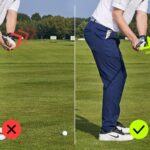
Learn how wrist action can help you consistently break 85 in golf.
Contents
What is the Significance of Breaking 85 in Golf?
Breaking 85 signifies that you’re a mid-handicapper and better than 74% of your peers, according to various reports citing the National Golf Foundation.
I’ve been unable to verify that statistic, but the NGF reports that most casual golfers exceed 90 over 18 holes. It also provides a solid platform to forge ahead and break 80 with a few tweaks to your strategy.
Planning to Consistently Break 85 in Golf
Understand Your Game
The first step is to analyze where you currently stand and what you can do in the immediate future to lower your gross score. I recommend writing down what club you hit, where it landed, and the rough yardage of that shot.
Obviously, some applications assist with record keeping, but I am old school and prefer a pen and pad. Identify which holes are your weakest and what clubs you currently use on them.
For example, change your tactics if you keep double bogeying a short par 4 because you hit a driver and end in the woods or a hazard.
Since the hole is brief, you needn’t take excessive risks. Instead, you could save shots by playing safe and hitting a long or mid-iron off the tee.
Besides distances and fairway position, take note of your greens in regulation (GIR), and which side you miss the green. Instead, increase your chances of staying on the dancefloor by aiming for the center and playing conservatively.
Finally, look at your current equipment setup and assess whether it provides sufficient forgiveness and consistency to your game. Game improvement golf clubs that promote an enhanced launch, straighter flight, and accelerated ball speed are suggested to lower the severity of mishits.
Read More: How to Break 90 in Golf Consistently.

Develop a Practice Plan
What is Important About Developing a Practice Plan?
After analyzing your on-course strengths and weaknesses, you take your findings and create an actionable training plan. A structured practice plan gives purpose to your sessions, helping you overcome specific imperfections in your game for more consistent results.
General Training Plan
I break my training down into a 45/40/15 split, with the better part of my time spent on my short game, followed by irons and fairway woods. 15% of the shots I hit in practice are with a driver because it is the club I use the least. On average, I use it on 4 holes per round, just under 5% of the time if I shoot 84.
Don’t get fixated on maximizing driver distance. Instead, balance your training to optimize your skills in all departments.

Mid and Long Iron Training
A typical day at the range starts with me hitting 5 pitching wedge shots as straight as possible to warm up my muscles and tempo. It also helps me get my eye in to generate cleanly struck shots.
Next, I hit 14 shots each with my 9, 8, 7, 6, 5, and 4-iron. In one session, I’ll focus on hitting straight shots.
Then, my following session zeros in on fades, followed by draws. I never just hit the ball. I am always attempting to induce a specific shape or height.
After I’ve worked on my irons, I typically take a 5-minute break to stretch and review my performance to see if I met my objectives.
Driver and Fairway Wood Practice
Next, I hit 14 shots each with my fairway woods and driver, still working on achieving a specific shape.
When I accomplish my goal with the long clubs, I meander to the practice green and spend the remainder of the time chipping and putting.
Chipping Practice
At this stage, I typically have an hour left of my 2-hour practice and usually start with hitting 10 pitch shots from 20 yards out to a radius of 3’ around the cup.
Then I tone it down and produce 10 chip shots from 10 yards out, still trying to stop the ball within the 3’ zone around the cup.
Up next are 10 bump-and-run shots from the fringe of the practice green, again aiming for the safe perimeter around the flagstick. Once satisfied with my chipping, I move behind a bunker or any available obstacle and hit 10 flop shots to the 3’ target.
The final part of chipping practice is to head into the bunker. I hit 10 shots from a specific lie each practice session to become accustomed to the strength, clubface angle, and strategy for escaping the sand in each lie.

Putting Practice
I reduce the radius around the cup to 2’ for putting as I aim to leave my long putts in a favorable position to get down in 2. I start putting from 10’, strike 10 putts, and work on landing more than 6 putts in the safe zone. After 10’, I up the ante to 20’ and repeat the process before proceeding to 30, then 40, and finally 50’.
These mammoth putts allow me to work on my lag putting and stroke control to produce a consistent roll from anywhere.
Post lag putting practice, I return to the 10’ mark and work on my short putts. I start at 10’, strike 10 putts, and see how many I sink.
Next, I putt 10 balls from 8’ then 6’, 5’, and finally, 3’. Ultimately, by the time I reach 3’, my mission is to sink every putt. This then brings my standard practice to a close, enabling me to work on all aspects of my game.

Shot-Specific Training Plan
You want to dedicate 10 to 15 shots at the end of each range session to hitting your driver or a fairway wood if your fairways in regulation (FIR) statistics are dismal.
Create an imaginary fairway and attempt to hit the short grass more than 50% of the time.
An improved FIR record sets me up for a smoother approach, boosting my chances of hitting the GIR and leaving me with a 2 putt for par. Conversely, if you’re missing GIR from the middle of the fairway, spend your session working on your short, mid, and long iron play.
Attempt to hit the driving range greens as many times as possible, but when you miss, take note of which side you are missing.
If you notice consistent right misses, you’re slicing or pushing the golf ball and have to work on squaring your clubface at contact. Conversely, left misses signal a hook or pull.
Simulate Your Next Round on the Range
Finally, another way I keep training interesting is to simulate a round of golf on my home course when I am on the range. I start my session by taking the club I use on the first tee, followed by the exact club I typically use on an approach shot.
Picture your position on the course and the shot needed to get your ball from its current location to your target.
For example, if the hole doglegs to the right and you slice your drive into the trees, you must hit a low, fading shot out the woods to get close to the green.
Envision the above scenarios and induce the desired shots. The more you employ this tactic on the range, the easier your decision-making and execution become on the golf course.

Strengthen Your Mental Game
Bobby Jones famously stated, “Competitive golf is played on a five-and-a-half inch course, the space between your ears.”
This applies to all golf, not just the big leagues, as an emotional golfer can quickly lose control of a round leading to catastrophic scorecards.
I’ve documented several golf mental tips before. However, the most important approach is to forget your previous shots and take them one step at a time.
As a mid-handicapper, you’re bound to hit a few poor shots. It’s how you recover that matters most.

Pre Shot Routine
I find employing a pre-shot routine breaks the tension caused by an undesirable strike and helps me focus on the next one.
In addition, I find breathing exercises eradicate distractions from my mind and give me the time to cool off and compose myself in between shots.
As a junior with a dream of becoming a pro, I would often talk negatively to myself after a bad shot and ultimately make a torrid scenario worse.
If I hit the ball into the trees, I immediately started thinking about how it would impact my score at the end of the round. That caused a loss in concentration, and irrational decisions ensued.
Instead, I should’ve taken a few breaths while walking to my ball and thought about my best options.
Then, once I approached my ball and decided on my plan of attack, I had to initiate my pre-shot routine and visualize escaping the mess.
One Shot at a Time
When I play with amateurs who are determined to break a specific score, I notice that it triggers anxiety. I see these players projecting their scores throughout the round, so focused on their overall gross, they forget to take it one shot at a time.
This also relaxes focus on the current task because your mind is switched to the end result. Dial it back and take it one shot at a time.
You can only control what is ahead of you, so pivot your attention to the shot at hand, and produce the best swing you can.
Take the one-shot-at-a-time approach, and you’ll soon find yourself unconcerned about the score. Instead, you’ll be preoccupied with your club selection and visualizing the ball flight on your next shot.
Breathing Exercises
Simple breathing exercises have helped immensely to control my emotions, stay in the moment, and maintain a positive mindset. I like to breathe in for 5 seconds, hold for 2, and breathe out for another 5 seconds over a 1-minute period while I walk to my ball.
It helps me alleviate anxiety, work, and personal distractions, leading me to forget about previous shots or my current score. When I reach my ball, I am relaxed and focused on the strike that lies ahead.
Laugh at Your Bad Shots
My final tip to strengthen your mental game is to laugh at your terrible shots and focus on enjoying your day out.
I started doing it in my early 20s, and it made a world of difference in controlling my emotions on the course.
Instead of figuratively beating myself up over the shot, I humor myself and my playing partners and quickly forget the mistake.

Strategize Each Hole
The final planning phase on how to break 85 comes down to strategizing for your round.
Before you walk to the first tee, visualize how you plan to play each hole with the club you’ll take from tee to green.
Not everything will go according to plan, and you must be prepared for the unexpected.
If your ball finds its way into the woods, don’t be a hero and chip it back into play to salvage the hole. In addition, if there are hazards in your line, lay up and reduce the risk of a lost ball and a stroke penalty.
Club Selection
As an aspiring mid-handicapper, you likely understand your average distances for each club in your bag.
When planning your hole, consider the club you’ll take from tee to green, and envision where those shots will end up based on their strength.
Where possible, try to leave yourself full shots with a specific club for improved distance control.
It is always risky sitting between distances and not knowing whether to take an extra club and grip down or force a weaker loft.
Fairway and Green Position
After picturing your club selection, visualize where each shot will finish from tee to green. For example, if the hole doglegs to the right, you want to play to the left side of the fairway to give you a clear route to the green.
In addition, I recommend visualizing your approach shots traveling to the middle of the green, which is a safer option than attacking a tight flag.
However, you can be bolder than usual if you have a pitching or sand wedge into the green and the flag is unguarded. On other occasions, the center of the green is advised.
Learn to perfect your wrist angles with our FREE online guide and break 85 with ease!
Tips to Break 85 in Golf Consistently
1. Control Your Wrists

The first tip to breaking 85 in golf is to learn to control your wrists from takeaway through contact because it impacts clubface control and accuracy.
Using the HackMotion wrist sensor, I noticed I was initially extending my wrists before impact, causing the shaft to steepen and the clubface to open.

It explained my consistently elevated launches, which veered to the right. However, since I’d operated like this for most of my life, I had adapted my alignment to the shape, which worked for me.
Since employing the HackMotion Pro, it is now guiding me to flex my wrists prior to impact to shallow the shaft and close the clubface. I find it easier to square the clubface at impact from this position to produce a straight ball flight.
To understand wrist flexion and extension, I recommend holding your hand out in front of you and standing in your address position. Push your fingers down, creating flexion in the wrists. Then, turn your hand so that your palms face toward your target.
The flexion has caused your palm to close to the target, which is the same effect it has on your golf club. Return to the original position with your hand directly in front of you. Now, push your fingers upward to create extension. Turn your palm to face the target, and look at how it is open to your desired mark.

2. Leave the Driver in the Bag
I’m sure telling amateurs to leave the driver in the bag will not sit well with many Kyle Berkshire fans who love bombing a tee shot.
However, breaking 85 is a lot tougher to achieve when your FIR record is dismal, thanks to the erratic performance of your big stick.
I only use my driver on par 5 holes and a handful of par 4’s if they’re super lengthy. I’m not the longest hitter in the world, but I find the average amateur golf course isn’t long enough to warrant using a driver on every par 4.
Occasionally, I turn to my trusted 2-driving iron or 3-iron for a lower launch, less curve, and improved accuracy. Since switching to this approach, I hit over 70% of my FIR.
Of course, it leaves me a long iron into some greens, but I’d rather that and still have a chance at hitting the GIR instead of chipping out from the trees.
3. Lay Up
Another tip that many amateurs, including my younger self, would not approve of, but astute players know differently.
Avoid putting yourself at risk and leaking shots when hazards are in play and instead lay up.
Many long-hitting mid handicappers will try to have a go at short par 5 greens for 2, even if water, fescue, or bunkers are in play. In these instances, pick a trusted iron, play to safety, and set yourself up for a short third shot, leaving you with a birdie putt.
When trying to break 85, you do not need birdies to achieve the feat. You need 12 bogeys and 6 pars.
You needn’t be aggressive to reach your goal, just be slow and steady. However, if there is no trouble ahead and you have the distance, then, by all means, try to reach a par 5 in 2.
4. Aim for the Middle of the Green
Another area I see mid-handicappers fall short is their ambition to attack every flag on the golf course.
While I admire that determination, it is an illogical approach that often leaves you in a tough spot to try and get up and down.
Always aim for the middle of the green on approach because it leaves you some wiggle room should you push or pull your shot. At least there’s a fighting chance your ball will remain on the green leaving you with a shot at Birdie.
Conversely, if you attack a flag on the left side of the green and hook your shot, you may end up in a greenside bunker or greenside rough. The same idea applies to a pin positioned on the right side of the green.
5. Take More Club
You’ll encounter moments on the course where you don’t have the correct club to cover the distance to your target.
This leaves us with the choice of swinging a higher lofted club fast and hard or gripping down on a stronger lofted model to take clubhead speed off.
I recommend taking an extra club, gripping down on it, and reducing your backswing length to account for the distance. Mentally, it makes me feel more comfortable that I have enough club to get to the target without trying to thrust my shot.
There is an exception to this tip.
When you have trouble behind the green, a shorter club is better to avoid overpowering your shot, ending in a hazard, and dropping a shot.
6. Improve Your Lag Putting
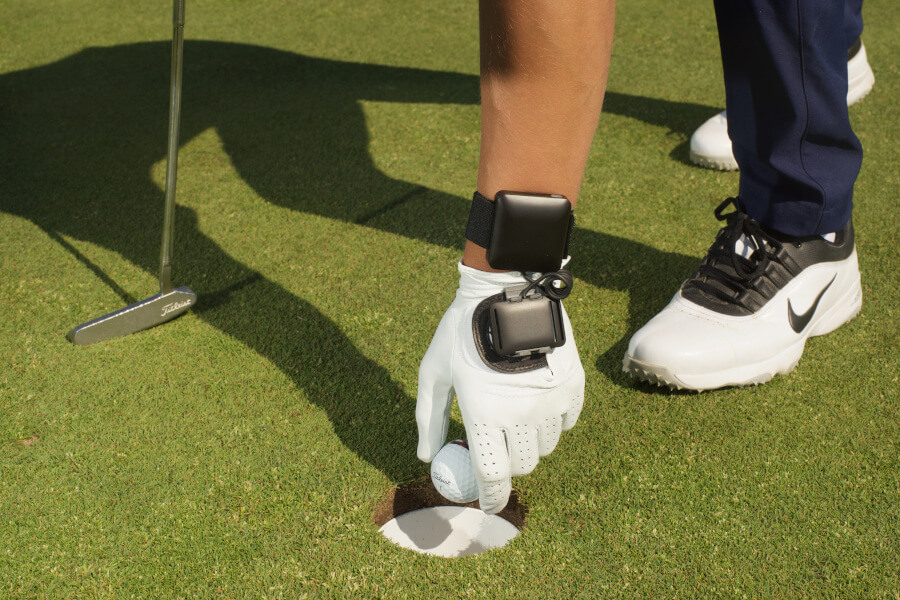
Lag-putting is pivotal to my consistency on the green. In a perfect world, I’d try to drain every putt I face, but you’ve got to pick your battles.
That’s where lag putting comes in, as you try to get the ball to within a 2 to 3’ radius of the cup on your first attempt, leaving an easy second putt.
Mastering lag putting requires optimal stroke and distance control, enabling you to get the ball close to the cup and limit 3 putts.
I work on my lag putting by using the tape measure drill and reworking Phil Mickelson’s structure to fit the courses I usually play.
The tape measure helps me see how far my backstroke is for a 10, 15, 20, 30, 40, and 50’ putt and make a mark at each point.
Next, I set 10 balls down at each marker and put the measuring tape in front of the golf ball to help me see where to stop my backstroke. Over time, the length of my backstroke became second nature, and I don’t need to look at the tape.
The muscle memory I developed from working on this drill has immensely helped my distance control.
7. 3 Wedge Swings
When your wedges are dialed, you can attack the flag on short shots and get the ball close for a makeable 1 putt.
Rick Shiels offers valuable advice on enhancing your wedge distance control with his 3 swing approach.
Grab your strongest lofted wedge and hit 10 shots with a half swing. Take your club back until your left arm is parallel to the ground. In clock terms, your hands should point to 9 o’clock. Then swing through until your right arm is parallel to the ground and your hand points to 3 o’clock. Take note of your distance for future shots.
Next, move to a ¾ backswing, where your left-hand points to 11 o’clock. Commence your downswing and follow through until your hands point to 1 o’clock. Once again, take note of the yardage. Finally, produce 10 full shots with the sand wedge and mark down the length of the shot.
Repeat the process with the next strongest lofted wedge, and close it with the weakest wedge in the bag.
Learn to perfect your wrist angles with our FREE online guide and break 85 with ease!
FAQs
How long does it take to break 85 in golf?
It could take an 18 handicapper 6 months to break 85, compared to a 36 handicapper who would need 2 to 3 years of consistent practice and dedication.
Ultimately, the time it takes to break 85 in golf varies based on your current handicap and frequency of training and play.
What percentage of golfers can break 85?
According to various authors who cite the National Golf Foundation, only 26% of amateur golfers break 85. However, I’ve not been able to verify the statistics with the source.
What would be my handicap if I shoot 85?
Your handicap would be 13 if you shoot 85 on a par 72 course. If the golf course is a par 71, your handicap would be 14, while a par 73 layout results in a handicap of 12.
Summary
Now that you have the theoretical knowledge on how to break 85, it’s time to analyze your current situation, develop a practice plan, and enhance your mental strength.
Next, I advise leaving your driver in the bag for accuracy off the tee and improving your lag putting to minimize 3 putts.
Finally, wrist control is imperative to your clubface control, ball flight, and accuracy.
Learn how you can leverage the advanced analytics of the HackMotion golf training aid to generate increased power through impact and straighter ball flight.