Fix That Hook – 6 Simple Steps to Stop Hooking the Ball in Golf

The worst part about a hook is that it often feels great when it comes off the clubface.
Usually, hooks are powerful, and you watch the golf ball head out straight before it starts making that ugly turn left.
After analyzing more than 1,000,000 golf swings of some of the best golfers in the world, we know the exact reasons why golfers hook, but more importantly, how to fix them!
Luckily, learning how to fix a hook is entirely possible and, if you ask us, considerably easier than fixing a slice. If it’s time to fix your hook and get familiar with the center of the fairway, you are in the right place.
How to Fix a Hook in Golf – Too Long, Didn’t Read
If you don’t have time to head to the range and work on all of our hook fixes and cures right now, here are a few of the most important facts to know about how to fix a hook in golf.
- Setup and alignment play a big part in how the clubface points at impact. To fix a hook, make sure your ball position is not too far forward in your stance and ensure you are not closing your shoulders and legs to the target.
- A grip that is too strong can cause a hook; ensure that your left hand (for right-handed players) is more down the center of the shaft and not turned too far to the right; strong grips can give you some power or the ability to release, but if you are overactive in that hand, the hook will show up.
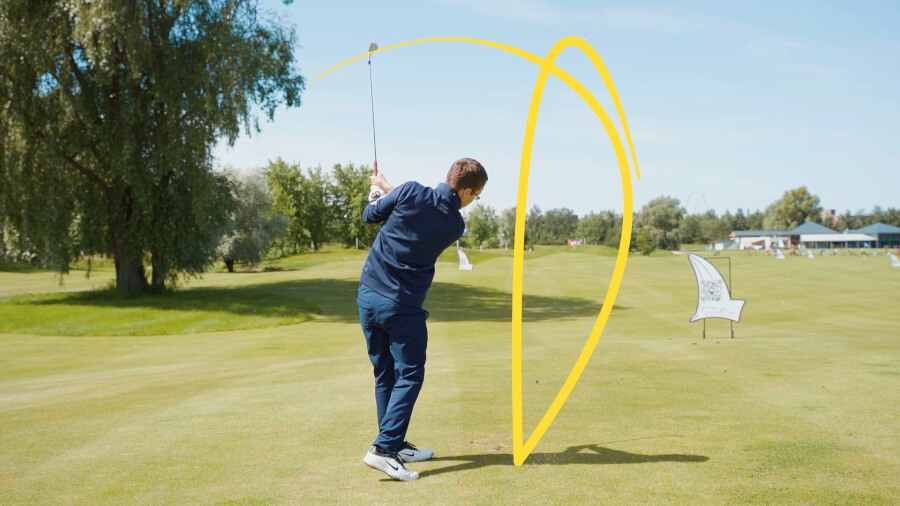
- A shallow swing path can make a hook even worse, although an upright path can lead to a slice; try to find that happy medium between shallow and steep. A proper setup and correct wrist position at the top of the swing will help with swing path issues.
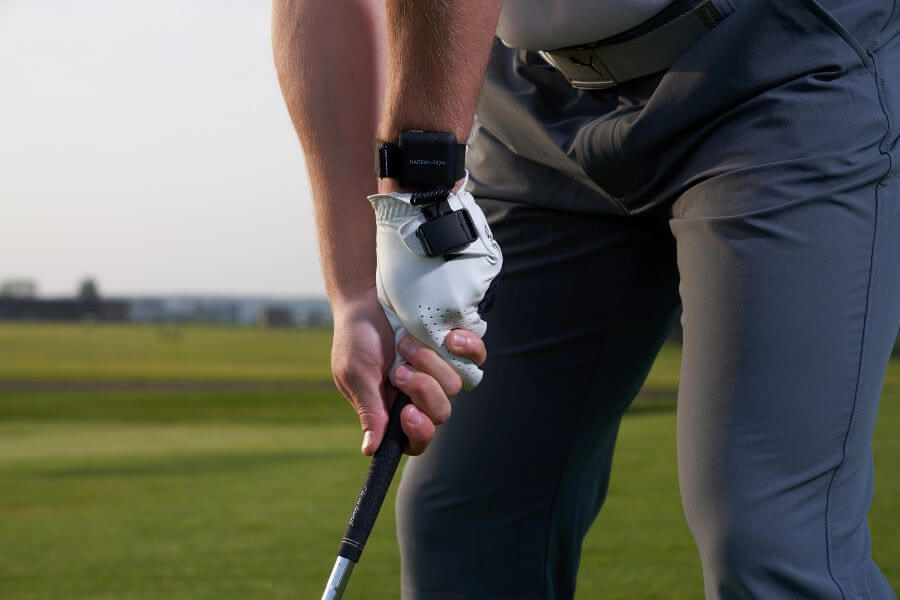
- The clubface must be square at impact to get rid of your hook. Golfers who hook the ball have a closed clubface and too much flexion in their lead wrist. HackMotion will help you measure your wrist angles and then correct them to square the clubface.
Contents
Golf Hook Causes: What to Look Out For
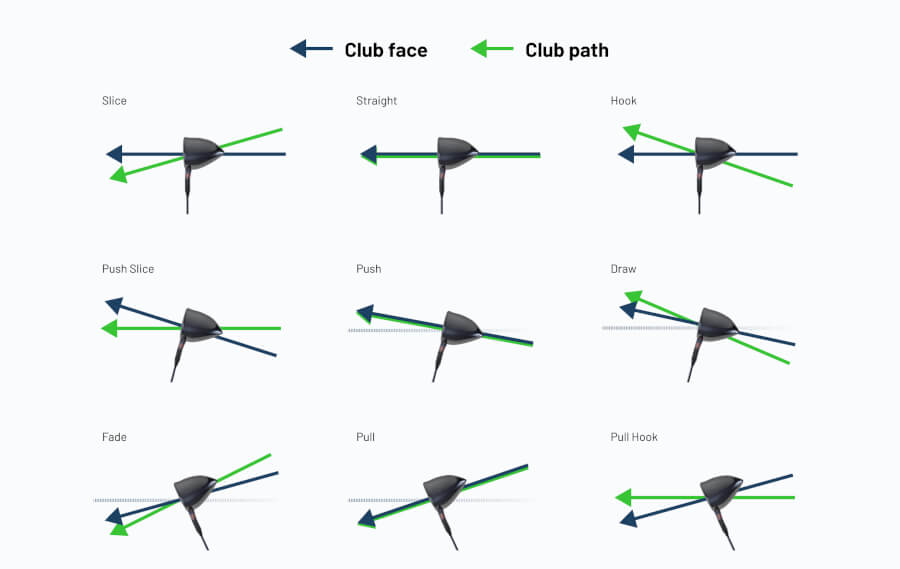
A golf hook is caused by a closed clubface at impact. If your clubface is closed, the ball goes left. However, there are a few things that can make hooking the ball a bit more pronounced or frequent.
A Grip That is Too Strong
When golfers slice the ball, the first thing that a coach will often tell them to do is strengthen their grip.
As you can imagine, the opposite is true for golfers that hook. If your grip is too strong, your left hand (for a right-handed player) will be twisted too far to the left.
The left hand turned to a strong position, in turn requires the right hand to fit more on the underside of the golf club.
From this position, the hands and wrists have a more dominant role in the clubface and what it does at impact. For the golfer that hooks, this is too much power. Moving the hands to a slightly weaker position can get the clubface more neutral at impact.
Setup Lines are Crossed
Amateur golfers are often completely unaware of how their setup position impacts their golf swing.
Most players have feet going one way, clubface another, and even hips and shoulders could be on their own line. This is not ideal.
If your clubface is not square to the rest of your stance, you could create a hook before you even take the club back. Setting up with alignment sticks in place is a great way to ensure you are ready to hit the golf ball soundly.
Shallow Swing Path
A shallow swing path has often been called one of the most common reasons behind a hook in golf.
However, a shallow swing path alone is not always the cause.
When you combine the shallow swing path with the closed clubface, you will see the hook get considerably worse. Having a more neutral swing path with a square clubface is the best position for any player.
From this position, you can focus more on speed and consistency through impact and forget all the other minute details.
Poor Wrist Action
The wrist action in your golf swing can also be a major culprit when it comes to hooking the golf ball.
Luckily, tools like HackMotion can diagnose the wrist issue and then give you the proper feedback in your practice routine to improve it. Wrist action at impact is important; however, if your wrist causes the clubface to close before impact, you may not have time to recover.
In this video, you can see how HackMotion can read your wrist angle on the takeaway, at the top of the swing, and again at impact.
With a tool like this, you can learn where exactly in your swing the wrist issues are occurring. For most golfers, it happens right in the takeaway.
Takeaways are easy to fix!
However, without HackMotion, many players work on fixing the top of their backswing instead of working on the takeaway. Take a look at how HackMotion can solve your hook for good.

Take control of your golf game and stop hooking by mastering wrist mechanics.
Fixing a Hook in Your Golf Swing (The Step-by-Step Guide)
Now that you have a better idea of how to determine what is causing your hook, let’s break down how to fix it.
I’m going to go through a few different ways to fix a hook, and one of them should do the trick to allow you to hit a straight golf shot again.
1. Grip Adjustment
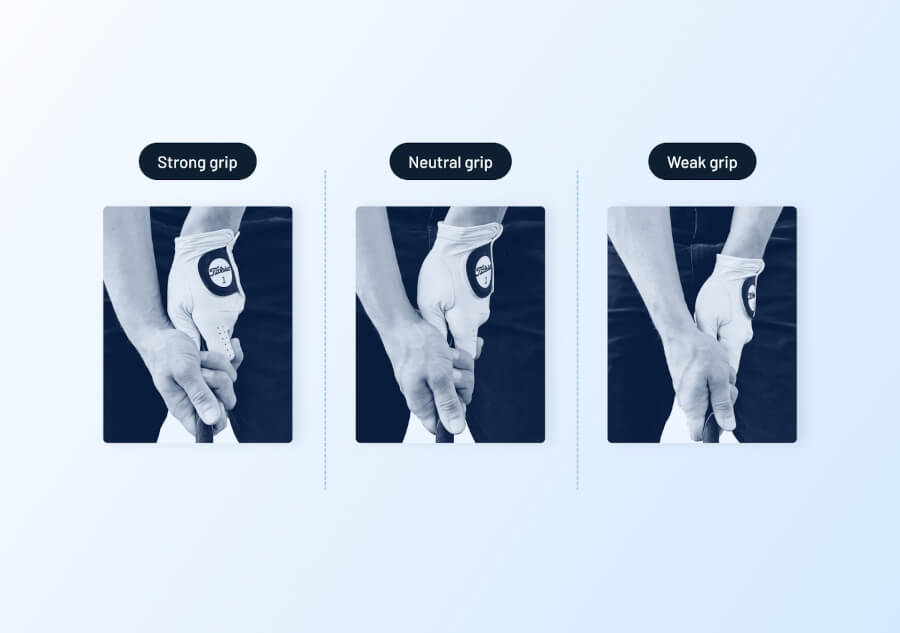
The grip to fix a hook requires that you have your hands in a more neutral position.
There are grip trainers out there, but you have to focus on getting the left hand in the proper position. Once the left hand is in place, the right hand will naturally follow.
Take the club and hold it mostly in the fingers of your left hand. Then place your hand down on the club so that your thumb points just right of the center of the shaft. If you can see the top part of your left hand from the address, you are already in a bad position that will require you to recover.
One of the benefits of HackMotion is that although it does not help you grip the club, it will analyze angles like this to ensure that your hands are in the proper location when you set up to swing.
Once the left hand is in the right place, interlock or overlap the right hand into position, which should be neutral.
Play around with a strong, weak, and neutral grip on the driving range; you will see how much of a difference it makes in your game. I find that to fix a hook a slightly weaker grip is often key. Once you have your grip correct, most towards aligning the clubface.
2. Align the Clubface Correctly to Start
Do you know what a square clubface looks like?
Every golf club has a different look to it, as well as different amounts of offset. In order to get your swing started out properly, the clubface needs to be aligned correctly to start.
The correct alignment needs to be square. A square clubface is where the bottom of the face sits at a 90-degree angle.
Golfers that hook the ball would decrease this angle and have the clubface pointing left of the target.
My favorite way to determine if my clubface is square is to find a straight edge, like the driving range station or a door jam, and place your club at the base. Comparing your idea of a square clubface to a true square clubface can be eye-opening.
3. Swing Path Alignment
As we discussed, as long as your club face is closed, the ball will go left regardless of your swing path. However, many players still worry that this shallow swing path causes the hook.
The shallow swing path can worsen the hook, but the wrist action is usually the root cause of the issue.
However, if you need to work on your swing path, one of the best ways to do it is with an alignment stick.
You can set up an alignment stick in the ground a few feet behind you, away from where it could get hit with the club.
As you swing back, look and see if your club is on a matching plane as this alignment stick or if it is starting out below it. If your swing path is starting out below it, you may have a swing that goes more around your body.
This tends to create more of a hook-type swing path, especially if the rotation in your swing is not timed perfectly. Again, work on getting the swing path closer to neutral, and you can get the hook to be less exaggerated.
Use our FREE guide to master your wrist angles and consistently hit straight shots with ease!
4. Wrist Action on the Takeaway
One of the best ways to check to see if your club face position is closed is to take the club back to waist high.
If you swing back to waist high, look at where the toe of the club is pointing.
- A neutral clubhead will have the toe pointing to the sky.
- A closed clubface will have the clubhead pointing down towards the ground.
If you set up with your clubface square, which has already closed between the takeaway and waist high, you have just figured out your problem.
The wrist action on the takeaway can make or break your golf swing the entire way. With the HackMotion wrist sensor, you can set the wrist angle so that you are alerted if you are to close it on the takeaway.
Closing the clubface on the takeaway is one of the most common reasons for a hook, but it’s simple to fix. When fixing a takeaway problem, incorporate the practice into your pre-shot routine.

5. Squaring the Clubface at Impact
Did you know that sometimes golfers (myself included) have a slightly closed clubface the entire time they swing?
However, these players know how to manipulate the clubface at impact to square it up and get a great shot.
For the majority of amateurs, you want to leave yourself a very small amount of work at impact. In fact, if there is no work and you can just swing through the ball freely, the results will be easier to repeat.

Golfers should be able to release the club as part of their downswing and impact position. Sometimes if your clubface is closed, you will have given up on this release, which can be a problem.
Instead, work on letting the club release the clubface will now be square if you made your other adjustments. The last thing you want is to turn a hook into a slice.
6. Equipment Check
We don’t like to give equipment too much credit for anything, but it does need to be mentioned here.
Setting your driver to open is not going to entirely fix your hook; you will also have to make some swing adjustments. However, if you’re playing with a club that is not meant for your game, it could make a slice considerably worse.
A golf club fitting can give you some idea as to what clubs you should be using and whether or not you need to make a change.
I’ve seen quite a few players using clubs that are too short for them, and this causes a significant hook. Sometimes slight adjustments can be made to the equipment, and a new club does not need to be purchased.
Troubleshooting the Hook in Golf: Things You Should Know
At this point, you have plenty of drills and information to be able to fix your hook. However, here are a few other tips that can help if you still find the left side of the golf course is coming into play more than it should.
Sometimes, a fix in a golf swing can come from a feeling or a visual in addition to the mechanical fixes.
- Don’t aim right at your target when you start hooking the golf ball; you may end up making the hook worse by overcorrecting the aim.
- Check to ensure you are not playing with a draw-biased golf club; these are designed for golfers who slice the ball, not those who hook it.
- It’s still a good idea to feel like you are swinging out to your target; this is necessary to generate power, distance, and accuracy.
- When tempo gets a little quick, it could make the results of a hooked golf shot a bit worse. Ease up on your tempo and see if that makes the issue any better.
- Take a video of your swing if you have the opportunity, compare the original video with the video after you make changes, and see how they differ.
Best Drills to Fix a Hook
The best way to fix a problem in your golf game is to find a way to “feel” what the issue is. Once you feel it, you can learn to repeat it.
Here are some of the best drills to get you to feel that square clubface at impact and hit a straight shot.
HackMotion Audio Feedback
If you can determine your wrist patterns at setup, the top of the backswing, and then again at impact, you may find some outliers. For most golfers, the hook causing issues to happen at the top of the swing where there is too much flexion in the left wrist.
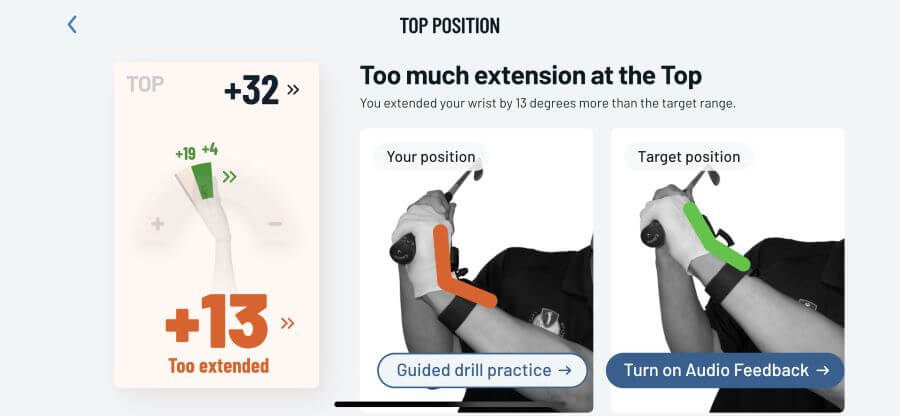
Set the audio feedback on the HackMotion to alert you when your wrist angles have fallen outside of the range of what would lead to a square clubface.
The best thing about HackMotion audio feedback is the fact that it occurs in real-time. Most golf technology alerts you to issues after you have already hit the ball.
The quickest way to fix your swing is to feel the issue and be alerted to it at the same time.

Be Aware of the Clubface
If your golf clubface tends to be closed and is causing your hook, you can learn to check the clubface at different positions in your swing.
- Setup to hit a regular shot.
- Swing back to halfway without taking your head off the ball.
- Look back to see where the clubface is. Has it opened if not, open it slightly so that it is square with the toe pointing up towards the sky at waist high.
- Repeat this drill until you are able to feel that slight opening of the clubface on the takeaway.
- Learn to incorporate this into your full swing if you feel it could be helpful.
Create a Runway
Use your golf alignment sticks to set up a path for your golf club to swing through. The first club will be set up parallel to the target line, the second will be slightly outside the target line and aimed more at the target.
Leave room for you to hit golf balls between these two sticks they are there for your visual aid.
Practice swinging the club along this inside-out path, where you hit shots between the two alignment sticks. You will stop from swinging too much from the inside or forgetting to throw the hands out towards the target (not too far out).
45 Degree Exit Drill
Eric Cognoro has a 45-degree exit drill to help golfers who are hooking the ball. Sometimes, the idea of inside out gets a little exaggerated with those who hit a hook. With this 45-degree exit drill, you can learn that you can come from the inside but still finish a little low and left.
Do this drill with an 8 iron, and go with about 70% swing speed when first working on this drill.
Summary
I would rather fix a hook than a slice any day. Hooking the golf ball usually means closing the clubface at some point during your swing.
Find out if this happens at set up, during the takeaway, at the top, or on the downswing.
Wrist action is a major factor in determining if your clubface is closing, and the HackMotion helps players perfect wrist angle throughout the entire swing.