The 10 Tips to Increase Clubhead Speed (Boost Your Golf Performance)

Accelerated clubhead speed leading into impact enhances your ability to transfer energy to the ball for a powerful launch.
In this post, I provide 10 tips that teach you to increase clubhead speed using a lighter shaft and employing optimal hip and shoulder rotation.
In addition, I explain how reduced grip pressure and rotating your wrists through contact can power the clubface through impact.
After reviewing this guide, you’ll know how to increase clubhead speed using the optimal equipment, grip, and wrist position and strengthening your core golf muscles.
The Best Way to Increase Clubhead Speed (Too Long, Didn’t Read)
- Swing a lighter shaft because it is easier to unload from the top and accelerate.
- Play a longer golf shaft to increase the distance traveled from top to bottom.
- Shallow the club at the top to position it as far from the ball as possible.
- Maximize hip and shoulder rotation to gain momentum on the downswing.
- Reduce grip pressure to enhance wrist hinge.
- Strengthen your core muscles for greater flexibility and less risk of injury.
- Rotate wrists through impact to produce added speed at the critical point of the swing.
- Smooth rhythm and tempo to optimize the transition.
Contents
10 Tips to Increase Golf Swing Speed
1. Lighter shaft
One approach to adding clubhead speed to your downswing is to play a lighter shaft, which offers greater torque, leverage, and flex.
The lighter a golf shaft, the better the level of flex, which provides added spring into the golf ball at impact for enhanced energy transfer.
For example, golfers swinging a driver between 72 to 83 mph may find their swing speed slowing with a 55-gram regular flex shaft compared to a 45-gram senior build.
The lighter senior flex delivers maximum whip into the ball, providing added velocity at a critical point in the swing.
The downside of a lighter, flexible shaft is that they typically contain a higher degree of torque, which is a blessing and a curse.
It increases twist to maximize your leverage but reduces your control.

2. Extend Your Shaft
The longer your shaft is, the more clubhead speed you produce due to the extended arch in your swing compared to short irons and wedges.
Using the Trackman statistics on PGA Tour players, we notice that the average driver speed is 6 mph faster than a 3-wood.
A stock driver shaft is 45.75 inches, while a 3-wood stretches 43.25 inches, over 2 inches shorter than the big stick.
This highlights how longer golf shafts deliver higher club head speed, and it is an option to lengthen your golf shaft.
However, think twice about it.
Longer golf shafts leave more time for golfers to send the club off path, leading to an off-center strike and loss of speed, distance, and accuracy.
Just because your clubhead speed accelerates into impact does not guarantee a powerful strike.
Catching the ball off-center undoes all that momentum and produces a weak smash factor, prompting a loss of distance.

3. Swing Weight
Lighter swing weight is another option if your clubs cost you velocity on the downswing.
The lightest swing weight is A0, while G9 is the heaviest option.
However, the standard men’s swing weight ranges from D1 to D3, while ladies stick to C5 to C7.
Reduced swing weight feels lighter in the hands and gives amateurs the sense we can let it rip to optimize speed.
Personally, I find my clubhead speed is considerably faster when swinging a C7 swing weight.
However, the added torque and flexibility often cause me to produce weaker-than-intended strikes.
Slower swing speeds may notice they are the easiest to unleash, despite the increased flex and twist of lighter swing weights.
While it is worth having a look, I suggest consulting a club fitter who can assist you with shaving off the desired weight.
Undertaking this task alone can cause irreparable damage to your clubs.
4. Shallow the Club
Shallowing your club at the top of your backswing positions the clubface as far as possible from the impact zone.
This leaves your club with increased room to gain momentum on the downswing and maximize velocity leading into contact.
Sergio Garcia provides the leading example of how to shallow the club. When he reaches the top, it looks like he is pulling a chain down.
This action prompts him to drop his arms into place and use the momentum of his hip and shoulder turn to power the clubface down to the golf ball.
Given the momentum he builds up through rotation and the distance the clubface has to travel, he generates exceptional clubhead speed.
Prime Sergio can deliver an average of 120 mph driver swing velocity.
5. Optimize Hip and Shoulder Turn
Hip and shoulder rotation is essential to maximize wind-up on the backswing and generate momentum on the downswing.
Without a decent turn, you leave your arms to do the heavy lifting, which costs you momentum and power into impact.
In addition, a lack of turn on the downswing makes it challenging to keep your club on path and square the face at contact for straight shots.
If I use Garcia as an example, you can see in the slow-motion replay of his swing that he generates maximum hip and shoulder turn on the downswing.
His hips and shoulders turn slightly on the backswing to get the club to the top.
Once he hits the top, he shallows the club and activates hip rotation to power the clubface down to impact.
The momentum generated from rotation helps keep the club on plane and accelerating into contact for accelerated clubhead speed.
Finally, Sergio can initiate clubhead lag by producing superior hip and shoulder turn on the downswing.
When your hips assume the drivers role and power your downswing, it causes the clubhead to lag behind and travel down to the golf ball using the momentum of your rotation.
6. Strengthen Core Golf Muscles
Your core muscles comprise the lower back, pelvic muscles, flanks, and glutes.
These are vital to your additional swing speed quest.
These muscles must remain flexible and in optimal shape to activate during your swing for superior power.
I recommend consistently implementing golf muscle exercises into your workout routine to keep them as flexible as possible. My four favorite drills for core strengthening are planks, dead bugs, Russian twists, and bird dogs.
PGA coach Thor Parish provides a brief visual representation of how you execute the four above exercises, which work your lower back, pelvic muscles, and glutes.
Besides enhancing your power and accuracy, healthy core muscles keep you safe by protecting your spine on each swing.
7. Reduce Grip Pressure
Reduced grip pressure enhances your control of the golf club and frees you up to activate wrist hinge on the downswing and power through to impact.
Excessive grip pressure prompts tense muscles, causing them to contract and restricting your ability to hinge your wrists.
An increased grip pressure creates a chain reaction as it causes your forearms to tense, and later your chest joins in.
When these body parts are rigid, you lose rotation, power, and wrist hinge on the downswing, causing a weak strike and a loss of distance.
In addition, a tense forearm and chest causes your body to tighten up and disables you from producing a fluid swing.
As a result, you lose rhythm and tempo, leading to an inconsistent transfer from the top down and the inability to unload the shaft for maximum power and speed.
8. Rotate Wrists Through Impact
Bryson DeChambeau is a prime example of how increased clubhead speed and power through impact do wonders for your distance.

The LIV Golf member achieves additional speed and power by rotating his wrists through impact. Coach Scott Cowx describes this phenomenon as “rotation release.”
Effectively, the power from your wrist rotation is transferred to the golf ball at impact, ensuring speed through the shot rather than relinquishing velocity at contact.
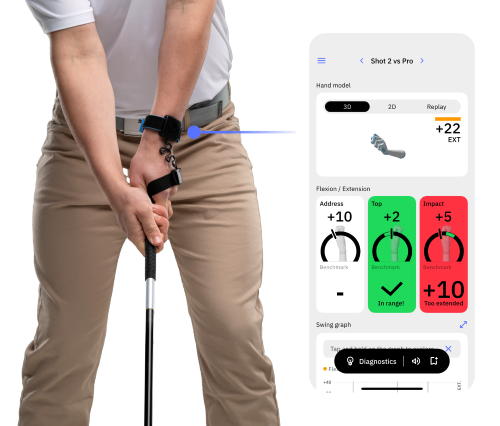
At address, his wrists sit with -13 degrees of flexion because he sets up with a forward shaft lean. He keeps the wrist stable on the backswing before employing 11 degrees of extension at the top of his swing.
From here, he is ready to produce pronation and work his wrist into a flexed or bowed position at impact.
Considering the differences in wrist angle at address and impact, he has to rotate the wrists significantly to get his clubface square at contact.
Ultimately, Bryson produces exceptional speed by relying on shoulder and hip rotation. Wrist angles are complex to understand. For a detailed guide on how the wrists work in the golf swing, you can check out this article by Golf Insider UK.
However, the HackMotion sensor gives you the insight to simplify the mystery. It offers detailed insight into your wrist positions and how they compare to PGA Tour pros for optimal results.
9. Warm Up Before Your Round
What should be routine before a round is often neglected by amateur golfers.
Stretching and warming up before your golf round is essential for loosening up your core muscles and enabling them to deliver optimal rotation and power in your swing.
There are various exercises to get warmed up, but I will keep it simple. Take the driver out of your bag, and grab the club head, so the grip is closest to the ground.
Use the club head weight and swing the shaft back and forth to awaken your core muscles and optimize shoulder and hip turn.
You can also do this before every shot to keep your muscles awake and ready for action.
10. Smooth Rhythm and Tempo
Generating a smooth rhythm and tempo helps you transition flawlessly from the top of your swing to the golf ball.
An erratic rhythm and tempo create insufficient shaft load at the top of your swing, leaving you with nothing to release on the downswing.
The more consistent your rhythm and tempo, the smoother the transition from the top down, unleashing maximum shaft power.
A simple drill I use frequently is to count from the start of my setup to the time I strike the ball.
I usually count 6 between address and impact, but your sweet point can be whatever you want.
The crucial point is to focus on the count and to let the transition from the top down come naturally with optimal power and speed.
You can briefly watch an example from Martin Hall on how he executes this drill, which I recommend employing in your practice routine.
Read More: How To Get Better At Golf Without Lessons.
FAQs
How to increase clubhead speed without losing accuracy?
You can increase clubhead speed without losing accuracy by producing lighter pressure, shallowing the club on the downswing, and optimizing hip and shoulder turn.
What is a good clubhead speed?
84 to 96 mph is a good clubhead speed for a driver if you are an average golfer.
Naturally, we all desire to swing the driver over 105 mph like a tour pro, but that is impossible for most golfers who do well to reach mid-90 mph swing speeds.
Will a lighter shaft increase clubhead speed?
Yes, a lighter shaft will increase swing speed because it is easier to release from the top of your backswing and accelerate on the way down.
However, some players may swing a heavier shaft better because they activate their core muscles and rely on them for speed and power.
What are the most important muscles in the golf swing?
The most important muscles in the golf swing include the hip flexors, pectoral muscles, lead-side lat muscles, and forearms.
All these muscles are responsible for boosting hip and shoulder rotation and keeping control of the clubhead throughout your swing.
Final Thoughts
Our guide on increasing clubhead speed highlights the importance of enhanced hip and shoulder rotation.
Besides generating optimal turn on the downswing, you require strong core muscles, lighter grip pressure, and rotated wrists through impact.
Lengthening your shaft and softening the flex is one approach to increasing clubhead speed, as is employing a lighter swing weight.
However, the best solution requires amendments to your swing mechanic mistakes, rotation, and wrist position.
Finally, consider what works for Bryson DeChambeau and look at rotating your wrists through impact for added speed.
I recommended leveraging the support and guidance of the HackMotion sensor.