Unlocking PGA Tour Secrets: Key Lessons from HackMotion Data

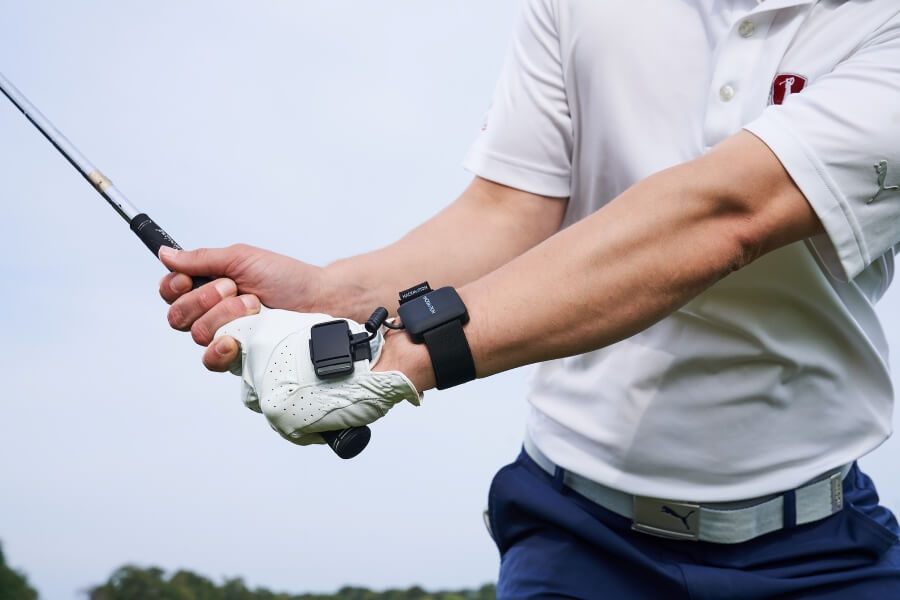
The HackMotion technology captures and analyzes data that is difficult to see with the naked eye. By measuring the wrist motion of tour players, the leading PGA instructors have learned several important lessons.
In this post, we have summarized the top findings from the wrist data and turned them into lessons to help you understand the concepts.
Watch the video below (18 min) to hear about the key lesson learned, and continue reading to find the resources mentioned.
Contents
- Lessons Learned from HackMotion Data
- There are Replicable Tour Player Release Patterns
- Wrist Extension is a Consistency Killer
- Pros Have Increasing Trail Wrist Extension in Transition
- An Increase in Wrist Action Knowledge Significantly Impacts Wrist Position
- Where HackMotion Data has the Most Impact
- Two Types of Wedge Shots Golfers Must Master
- Functional vs. Non-functional Putting Stroke Patterns
- Putting Path is Much Less Important than Putting Consistency
- The More HackMotion is Used, The More Effective It is
- Initial Setup Position is Far Less Important than the Difference Between Setup and Impact
- Get Your HackMotion Today
Lessons Learned from HackMotion Data
There are Replicable Tour Player Release Patterns
PGA coach Scott Cowx has identified the 2 most popular patterns tour players use.
- Option A – Stable Wrist Flexion/Extension pattern (Tommy Fleetwood)
- Option B – Flexion toward Extension, Less Rotation (DJ Pattern)

The most suitable pattern for the majority of golfers is Wrist Option A. A golfer starts with a certain amount of extension, keeps that extension consistent to the top of the swing, and then decreases extension and moves towards flexion through impact.
It’s used by players like Tommy Fleetwood, Tiger Woods, and Rory McIlroy.
These golfers are usually great at hitting stingers and different shot shapes. Great wedge players, pitchers, and chippers – because they learn to control the loft of the club.
The DJ or Collin Morikawa-type pattern has a great deal of flexion at the top and moves towards extension on the downswing. However, at impact, there is still flexion.
Dustin Johnson’s pattern would look like something like this:
- Address – DJ has an average amount of extension – 25 degrees.
- Top of the Backswing – reaches -45 degrees of flexion. He has moved towards flexion 70 degrees when compared to the address! (25+45=70)
- Impact – still very flexed, but much less than he was at the top, only -21 deg.
Wrist Extension is a Consistency Killer
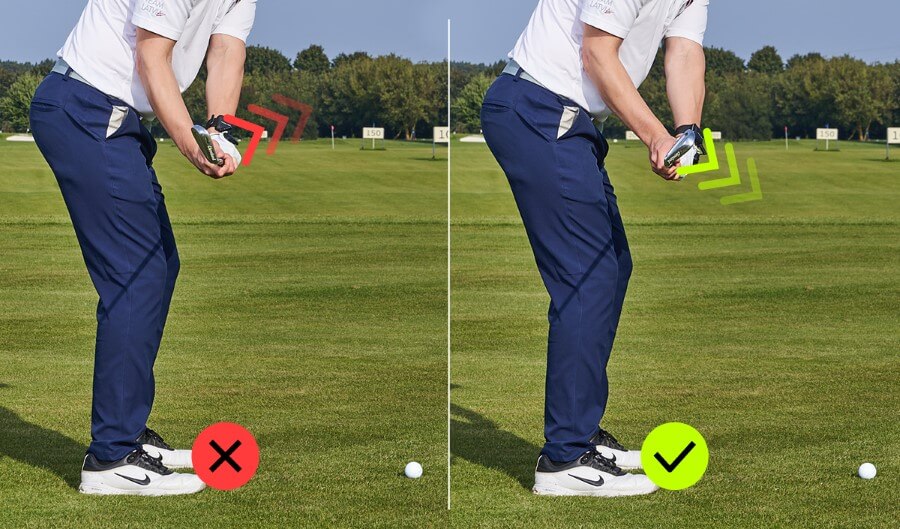
Excessive lead wrist extension is a common example of poor wrist mechanics among club golfers. The wrist extension opens the clubface, and the more the face is open, the more it needs to be closed again to hit the ball straight. This leads to inconsistency in clubface control and shot direction.
We have also learned that golfers who are able to decrease the amount of extension in their wrists closer to the transition instead of closer to impact can have an easier time increasing clubhead speed.
If you are moving towards impact and you are still extended, you are losing speed to try and square the clubface.
Bad Example:


Good Example: Tommy Fleetwood
Pros Have Increasing Trail Wrist Extension in Transition
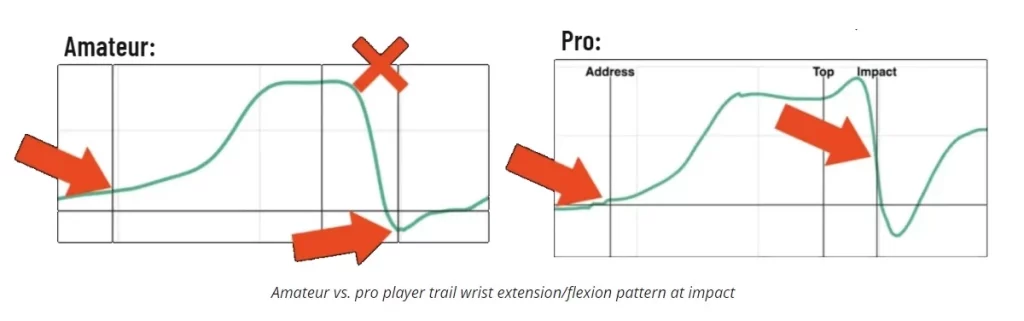
European Tour coach Christoph Bausek has identified a common trail wrist pattern among pro players. Pros are increasing trail wrist extension in transition. Although HackMotion focuses mostly on the lead wrist, as this is easier for golfers to feel and understand, trail wrist extension and lead wrist extension can work together.
Learn more about this trail wrist pattern HERE.
An Increase in Wrist Action Knowledge Significantly Impacts Wrist Position
We have found that golfers swing progressively worse as knowledge of wrist action decreases. A golfer with less than a 10 handicap that has expert-level knowledge of wrist mechanics is significantly more flexed at the top of their backswing than golfers who lack this knowledge.
Golfers with a 25+ handicap that have some knowledge and understanding of wrist mechanics outperform golfers with no knowledge. At the top of their backswing, they tend to be more in range, and the impact is less extended (although typically still a little extended).
Wrist action is no longer a topic you can ignore.
Where HackMotion Data has the Most Impact
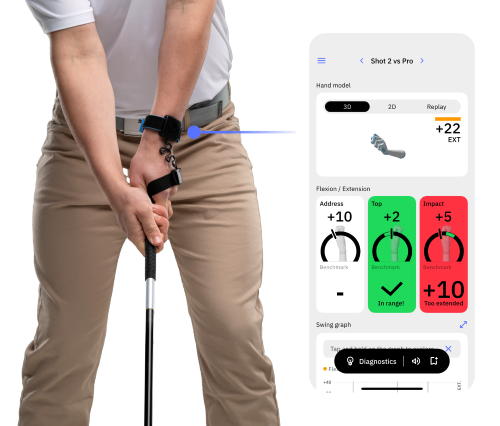
By conducting studies and analyzing more than a million golf swings, we know that HackMotion is a tremendous slice fixer.
A slice is caused by an open clubface, and the wrist controls the position of the clubface throughout the swing. For golfers in the mid-handicap range of 10-25, the HackMotion helped to get the impact position to the 0 to +2 extension range, which is nearly perfect.
Even golfers in the 25+ handicap range extension at impact, on average, got down to the +5 range. HackMotion does have the ability to correct a slice, a common miss seen by golfers in the under 10 handicap range.
Two Types of Wedge Shots Golfers Must Master
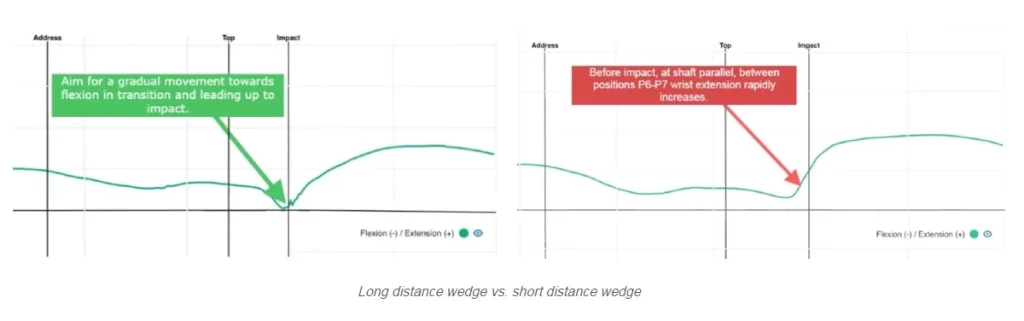
Mark Blackburn (PGA Coach of the Year 2020) and Layne Savoi (Co-founder of WedgeCraft) have developed a concept called “Two-Sided Spin Mountain.”
It explains how to master short vs. long-distance wedges to be able to create desired launch angle and spin rate. Learn more HERE.
Functional vs. Non-functional Putting Stroke Patterns
Tour putting coach David Orr has explained there are certain wrist sequences that are very repeatable and functional, and some are not. For example, excessive trail hand movement into flexion in the backswing and “throwing” motion in transition leads to inconsistencies.
- Learn more about functional trail wrist patterns HERE.
- Check Brad Faxon’s lead wrist putting data HERE.
Putting Path is Much Less Important than Putting Consistency
The role of the wrist action in putting is incredibly important to developing consistency. Even golfers that have a straight back and straight through putting stroke will still have a slight arc.
To perfect this arc and to keep your putter face within range and square at impact, you need consistency in the movement. HackMotion data will show you whether your putting stroke is within range or if each stroke is entirely different.
The More HackMotion is Used, The More Effective It is
HackMotion is a feedback tool that offers information to golfers as they are using it. Therefore learning happens quickly. Our data shows that 73% of golfers see a significant improvement in their game after just 2 weeks of using HackMotion. However, to truly see improvement, you have to stay consistent with your learning.
On average, golfers that practice more than 2-3 times a week with their HackMotion can get the top position in the backswing within range (regardless of handicap) and get to a less extended and even slightly flexed position at impact.
Initial Setup Position is Far Less Important than the Difference Between Setup and Impact

Every golfer has different physical characteristics and approaches the game of golf in their own unique way. The data at setup is mostly important in relation to the position at the top of the backswing and the position at impact.
Golfers can be quite extended at impact but lose that extension as they swing back and decrease it even more at impact. Other players may be slightly flexed at setup, get a little extended and then lose all that extension.
The key is to look for the patterns, and what feels repeatable, HackMotion has proved there is no perfect wrist position, only perfect patterns and sequences.
Get Your HackMotion Today
HackMotion allows you to collect data about your golf game that you have never been able to collect. Use the benefits of the HackMotion device to improve your game and increase your understanding of what controls a golf ball.
There is power in knowing how to control the clubface; every great player knows this.